Triangle (Zigzag) vs. Square Plant Spacing: When Do Zigzag Rows Fit More Plants?
Learn why zigzag rows fit about 15% more plants in open yards—and why smaller wooden raised beds sometimes end up holding fewer plants.
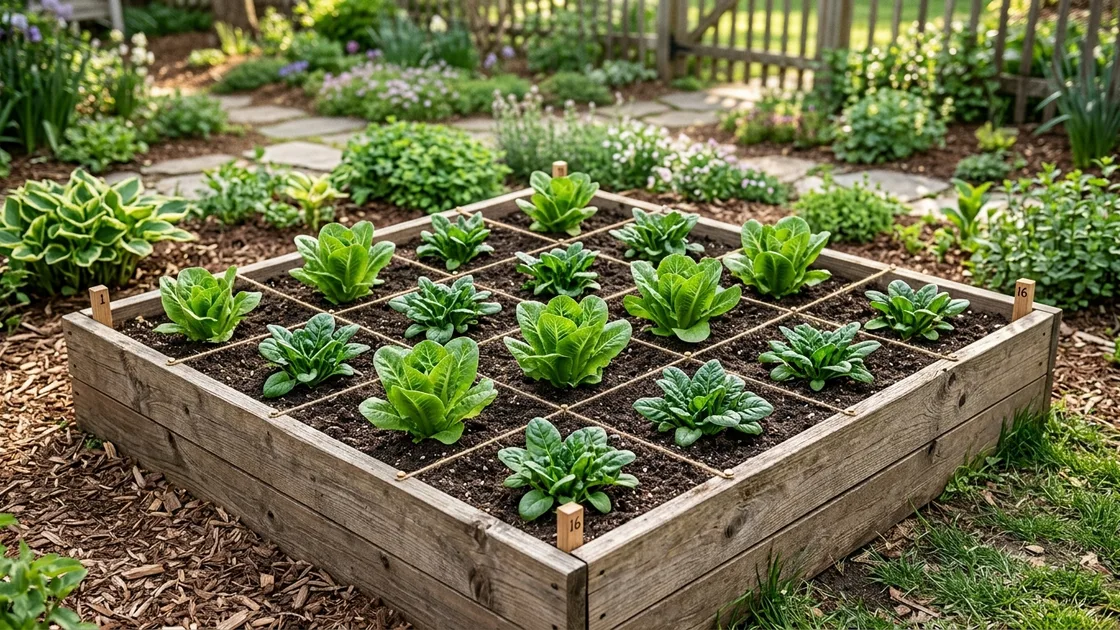
Nearly every gardener eventually hears an exciting gardening tip: if you shift your plants into a zigzag (triangle) pattern instead of straight square rows, you can fit about 15.5% more plants in the same space.
On paper, that sounds like free bonus food—more strawberries, lettuce, or flowers without building another garden bed.
Yet when gardeners try setting up zigzag rows inside a real 4×8 ft wooden raised bed or along a narrow border, many are surprised to find the exact opposite: the zigzag layout actually fits fewer plants than a straight square grid.
Why does zigzag spacing look great in textbooks yet lose spots inside a standard 4×8 bed? In this guide, we show you how the 15.5% extra-room rule works, explain the Raised-Bed Edge Catch, highlight real garden perks like fewer weeds, and show when you should (and shouldn’t) zigzag your rows.
1. Why Zigzag Rows Fit More Plants in Wide Open Spaces
Imagine packing round coins or round leafy plants onto a large table. You can line them up in neat rows and columns, or you can nest every second row snugly into the curves between the first row’s plants.
Straight Square Grid
In a standard square grid, every plant sits in lined-up rows and columns at the same spacing:
- Distance side-to-side along the row: Plant Spacing
- Distance front-to-back between rows: Plant Spacing
- Total soil space per plant:
Square Space per Plant = Spacing × Spacing
With 12-inch spacing (1 ft), each plant gets 1.0 sq ft (144 sq inches) of ground.
Zigzag (Triangle) Layout
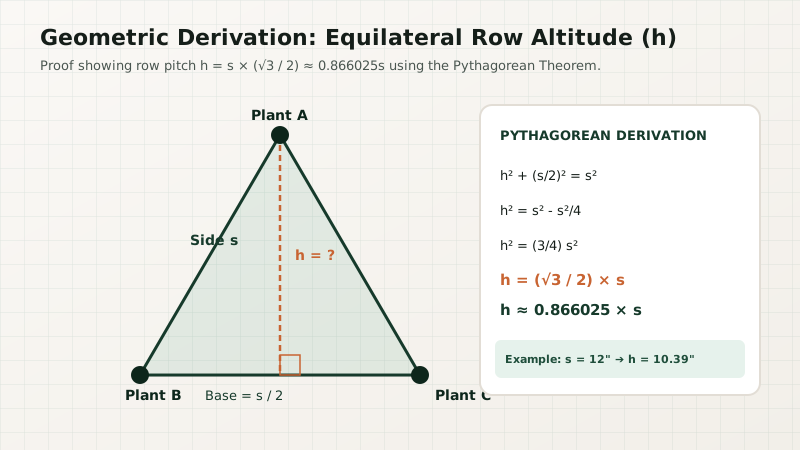
In an equal-sided triangle pattern, every plant sits the exact same distance away from all six of its closest neighbors. To do this, every second row shifts sideways by half a spacing, tucking into the gaps of the row in front of it.
Because those rows nest together, the front-to-back distance between rows shrinks slightly:
Distance Between Zigzag Rows ≈ 0.866 × Plant Spacing
For a crop spaced 12 inches apart, the distance between rows drops from 12” down to:
0.866 × 12” = 10.39 inches
How Much Space Does That Save?
Each plant in a large zigzag layout uses about 86.6% of the ground area of a square grid. That means in wide, open garden plots, tight nesting fills roughly 90.7% of the soil surface compared to 78.5% for squares—giving room for +15.5% more plants overall!
2. The Raised-Bed Edge Catch: Why Small Beds Can Lose Plants
If zigzag rows save space, why do home gardeners often see fewer plants inside a raised bed?
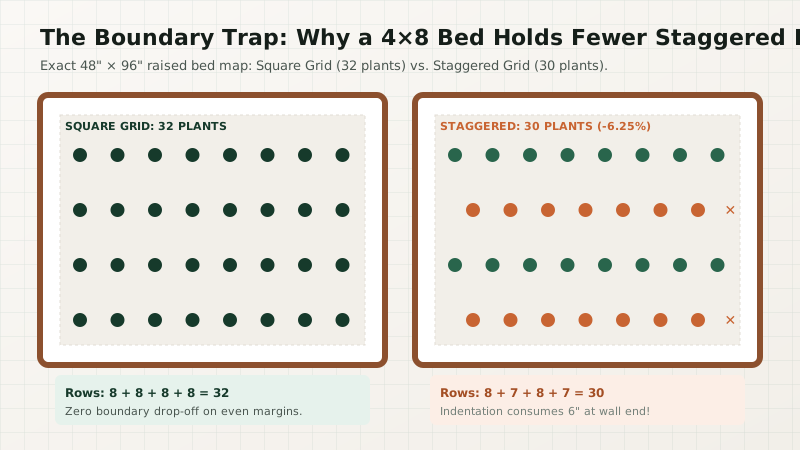
Because wooden bed walls don’t shift with your zigzag rows. When you shift every second row sideways by half a plant width, that row starts farther from the left wall—often knocking off the last plant on the right end before it touches the wooden wall!
Real Example: A Standard 4×8 ft Raised Bed
Imagine a classic 4×8 ft bed (48” × 96”) planted with peppers, kale, or chard at 12-inch spacing, leaving a 6-inch edge gap around all wooden sides so roots don’t dry out against the boards.
Layout A: Straight Square Grid
- Usable Inside Space:
- Width: 48” − 6” − 6” = 36”
- Length: 96” − 6” − 6” = 84”
- Counts:
- Rows across: 36” ÷ 12” = 3 spaces + 1 starting plant = 4 rows
- Plants per row: 84” ÷ 12” = 7 spaces + 1 = 8 plants
- Total Square Capacity: 4 rows × 8 plants = 32 plants
Layout B: Zigzag Grid
- How Many Rows Fit Across?
- Row spacing shrinks from 12” to 10.39”.
- Check how many rows fit inside 36”: 36” ÷ 10.39” = 3.46. Rounding down + 1 = still only 4 rows! (Fitting a 5th row would take about 41.6” of usable width, so that saved room goes unused.)
- How Many Plants Fit in Each Row?
- Row 1: Starts at 6”, ends cleanly at 90”. Fits 8 plants.
- Row 2 (shifted right by 6”): Starts at 12”. Only 78” left before the 90” right limit. Fits 6 spaces + 1 = 7 plants (lost 1 plant!).
- Row 3: Starts back at 6”. Fits 8 plants.
- Row 4 (shifted right by 6”): Fits 7 plants (lost another plant!).
- Total Zigzag Capacity: 8 + 7 + 8 + 7 = 30 plants
The Surprising Winner: Square Grid by 2 Plants
Instead of gaining 15%, shifting this 4×8 ft bed into a zigzag lost 2 plants (30 vs 32). The little bit of width saved between rows wasn’t enough to add a 5th row, while shifting Rows 2 and 4 pushed one plant off the end of each!
3. When Does Zigzag Spacing Actually Win?
Zigzag triangle spacing really shines whenever one of two things happens:
- You Unlock an Extra Row: The narrower row spacing lets you squeeze in one full extra row across your bed width that wouldn’t fit straight.
- You Have a Large or Long Plot: In big beds with 10+ rows, extra rows quickly outweigh losing half a spot on every other end.
Example: A 4×10 ft Bed (48” × 120”) at 10-Inch Spacing
With 10” spacing and a 5” edge gap:
- Usable width: 48” − 10” = 38”.
- Usable length: 120” − 10” = 110”.
Square Grid:
- Rows across: Round Down(38 ÷ 10) + 1 = 4 rows
- Plants per row: Round Down(110 ÷ 10) + 1 = 12 plants
- Total: 4 × 12 = 48 plants
Zigzag Triangle Grid (row spacing = 8.66”):
- Rows across: Round Down(38 ÷ 8.66) + 1 = 4 + 1 = 5 rows (A whole 5th row fits!)
- Row 1: 12 | Row 2: 11 | Row 3: 12 | Row 4: 11 | Row 5: 12
- Total: 12 + 11 + 12 + 11 + 12 = 58 plants
The Result: 58 plants vs. 48 plants—that’s a +20.8% gain!
4. Other Reasons Gardeners Love Zigzag Spacing
Even when a zigzag layout holds the same number of plants, it comes with three huge everyday advantages:
1. Faster Shade & Fewer Weeds
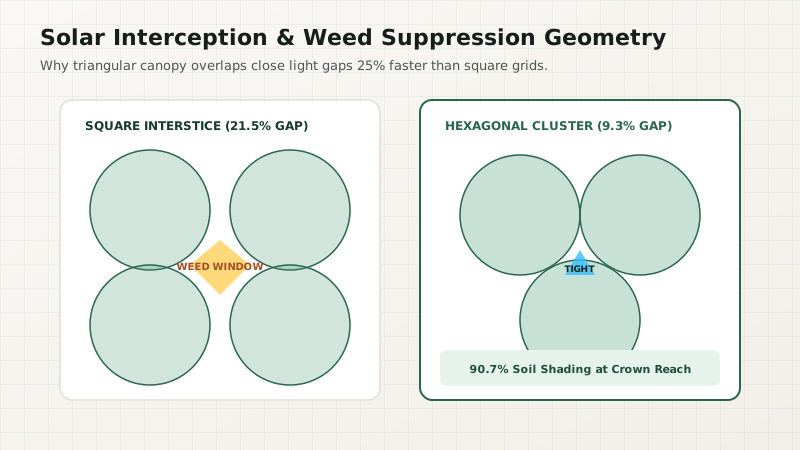
Look at Figure 3 above: four plants in a square leave an open sunlit diamond in the middle covering 21.5% of the bed. Weed seeds love that warm spotlight.
Three plants in a triangle leave a tiny middle gap covering only 9.3% of the dirt. Leaves shade the soil much earlier in spring, acting like living mulch that holds moisture and chokes out weeds.
2. Equal Root Space All Around
In a square grid, a plant’s diagonal neighbors sit 41% farther away than its front and side neighbors, creating unused pockets of dirt in the corners. In a zigzag layout, all six neighbors sit at the exact same distance apart, so roots spread evenly in every direction.
3. Better Privacy & Wind Blocking for Hedges
Single-row privacy hedges often leave thin peek-through gaps between trunks for the first few years. Placing two rows in a zigzag lines up every second shrub directly behind the gap of the front row, blocking sightlines and wind gusts twice as fast.
5. When Straight Square Grids Are Still Easier
Even with all those perks, vegetable farmers and backyard growers often stick with straight square grids for everyday convenience:
- Easy Weeding Both Ways: In a square grid, you can run a hand hoe or wheel hoe straight down rows and straight across columns. With zigzag plants, you have to weave diagonally.
- Simple Drip Irrigation: Pre-drilled drip hoses want to lie in straight lines, not bend back and forth around zigzagged stems.
- Neat Trellising & Staking: Heavy climbing tomatoes, cages, and pole beans are far easier to tie up, reach into, and harvest along straight rows.
6. Quick Comparison Side-by-Side
| Garden Feature | Straight Square Grid | Zigzag Pattern (Triangle) |
|---|---|---|
| Big Field Capacity | Standard (100%) | Up to +15.5% more plants |
| Standard 4×8 Bed (12” spacing) | 32 plants (Winner) | 30 plants (2 fewer plants) |
| Leaf Shading & Moisture | Normal | Fastest (fills bare gaps sooner) |
| Blocking Weeds | Good (21.5% sunlit gap) | Best (only 9.3% sunlit gap) |
| Drip Tape Setup | Very easy, straight hoses | Harder; needs angled lines or sprayers |
| Hand Weeding | Straight front-to-back & side-to-side | Diagonal paths only |
| Best Crops to Use | Staked tomatoes, corn, straight salad beds | Strawberries, groundcovers, spring bulbs, flowers |
7. How to Mark a Zigzag Pattern Outside in 5 Steps
Ready to lay out a zigzag bed or flower border? All you need is string, wooden stakes, and a tape measure:
- String Row 1 Straight: Pull a tight string along your first straight edge and mark spots at your plant spacing (for example, 0”, 12”, 24”, 36”).
- Find Your Next Row Distance: Multiply your plant spacing by 0.866. For 12-inch spacing, your next row string goes 10.4 inches back.
- Pull Row 2 Parallel: Measure 10.4” over at both ends and pull a second tight string parallel to Row 1.
- Shift the First Spot Halfway Over: On Row 2, start your first mark half a spacing (6”) in from the starting edge, then mark every 12” from there.
- Double-Check One Triangle: Measure from a spot on Row 2 to the two closest spots on Row 1—all three points should measure 12 inches apart!
Frequently Asked Questions
Does squeezing in 15% more plants always give a 15% bigger harvest?
Not always! Leafy greens, herbs, and groundcovers love close zigzag spacing because they fill bare ground fast. Heavy fruiting plants like tomatoes and bell peppers, however, still need plenty of sun and food—if packed past their comfort zone, total weight stays similar while each tomato grows smaller.
Should I use zigzag spacing for Square Foot Gardening?
No—Square Foot Gardening works best with its standard 1×1 ft square boxes holding 1, 4, 9, or 16 plants per square. Shifting across grid lines makes crop rotation and replanting single squares much harder.
Is zigzag spacing good for groundcovers and lawn plugs?
Yes! For creeping thyme, clover, mondo grass, or pachysandra plugs, zigzag planting is the gold standard. It fills bare dirt roughly a whole season faster than square grids, stopping soil washout and cutting way down on weeding.
Helpful Interactive Calculators
- Zigzag (Triangular) Spacing Calculator — Enter your exact bed dimensions to check right away if zigzag rows add or lose plants.
- Plant Density & Area Calculator — Compare plants per square foot, square meter, or acre between square and zigzag layouts.
- Main Garden Spacing Calculator — Flip between Square and Zigzag patterns live on an interactive garden grid.
- Strawberry Spacing Calculator — Plan zigzag berry beds and rows for big spring harvests.