Raised Bed Plant Spacing Guide: Bed Sizes, Soil Depth, and How Many Plants Fit
See exact plant counts for 4×8, 4×4, and 3×6 raised beds, learn how to calculate soil bags or cubic yards, and arrange tall and short crops for full sun.
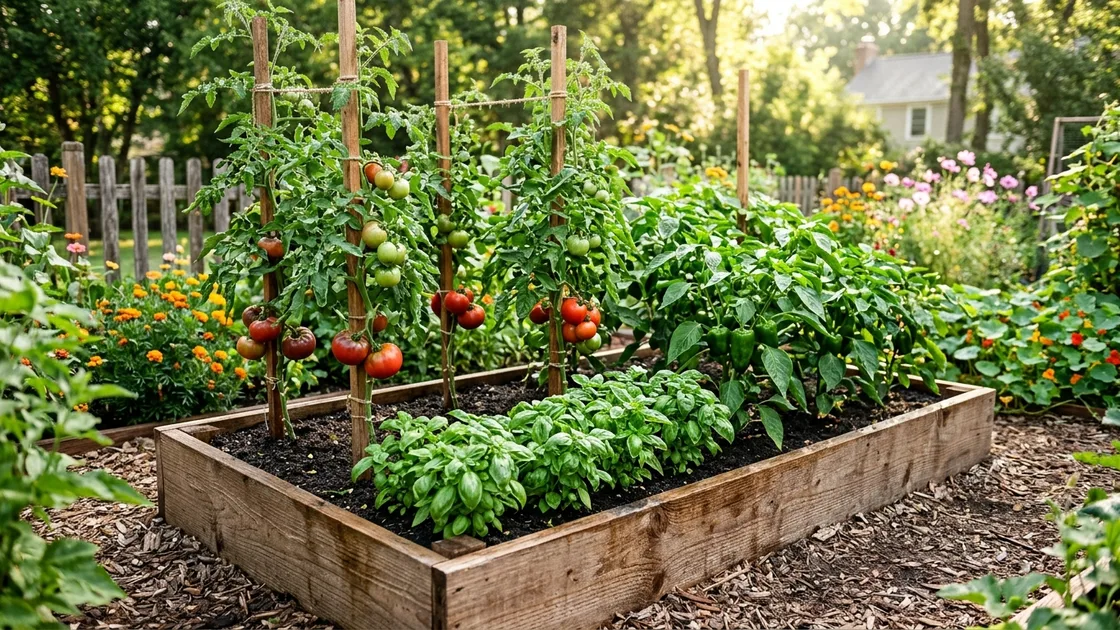
Raised bed gardening is one of the easiest, most productive ways to grow fresh vegetables at home. Lifting your soil inside a cedar, metal, or stone frame keeps you from stepping on and squishing the dirt, drains heavy rain quickly in clay yards, and helps your garden warm up two to three weeks sooner in spring.
Because nobody walks inside a raised bed, the loose, fluffy soil lets you plant crops closer together than in wide farm rows.
Still, tight beds make spacing mistakes easy to spot. Crowding plants blocks airflow and invites powdery mildew and spider mites, while drying out the soil too fast. Spacing plants too wide wastes costly compost and gives weeds extra room to sprout.
In this step-by-step guide, we break down exact plant counts for the three most popular raised bed sizes (4×8 ft, 4×4 ft, and 3×6 ft), explain how to subtract wood board thickness, calculate bags of Mel’s Mix soil, leave safe wall gaps, and layer tall and short crops so every leaf catches sunshine.
1. Choosing a Raised Bed Size You Can Comfortably Reach
Pick a bed frame size that fits your yard and keeps the middle easy to reach without stepping inside:
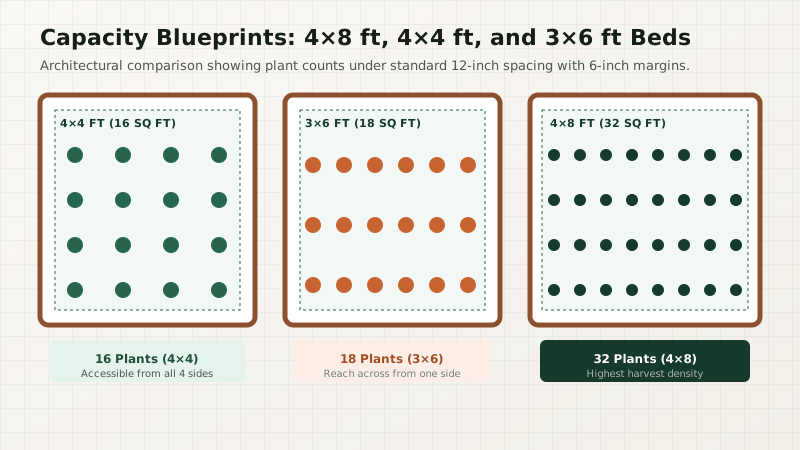
The 4×8 ft Bed (32 sq ft): The Backyard Favorite
- Best For: Biggest vegetable harvests, plenty of variety, and adding a tall trellis.
- Easy Reach: Four feet is the classic rule of thumb because most adults can comfortably reach 2 feet (24”) inward. Standing on either long side lets you harvest the middle without leaning awkwardly or stepping in the dirt.
- How Much Fits: 32 plants at 12-inch spacing, or up to 512 carrots at 3-inch spacing.
The 4×4 ft Bed (16 sq ft): The All-Around Square
- Best For: Small yards, patios, Square Foot Gardening, and first-time growers.
- Easy Reach: Easy to reach from all four sides. Splits neatly into sixteen 1×1 ft squares.
- How Much Fits: 16 plants at 12-inch spacing, or 64 plants at 6-inch spacing.
The 3×6 ft Bed (18 sq ft): The Reach-Across Narrow Bed
- Best For: Side yards, fences, wheelchair access, or beds tucked against a house or garage wall.
- Easy Reach: When you can only stand on one long side of a bed, 4 feet is too far to stretch. A 3-foot width lets you comfortably reach all the way to the back board from the front path.
- How Much Fits: 18 plants at 12-inch spacing.
2. Always Measure Inside the Wood Walls
One of the biggest surprises in raised bed math is that store lumber dimensions are thicker than they sound—so your actual dirt space is smaller than 4×8 feet!
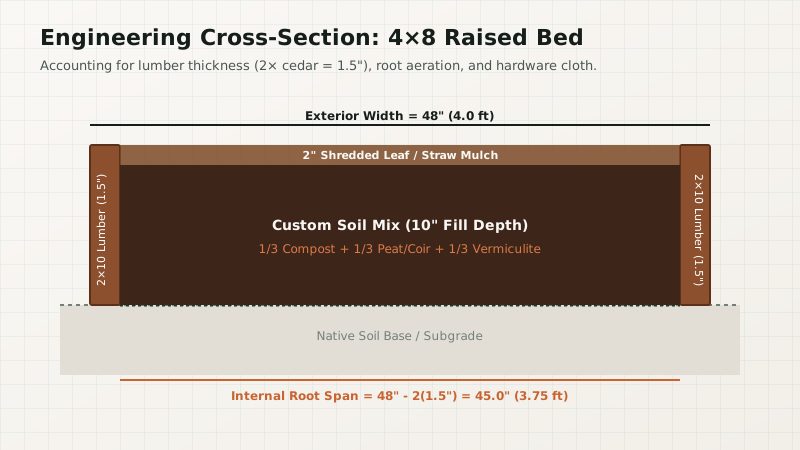
When lumber is milled and sanded smooth, the boards end up thinner than their store label:
- Standard 2×10 or 2×12 Boards: Really 1.5 inches thick.
- Standard 1× Cedar Boards: Really 0.75 inches thick.
- Heavy Landscape Timbers: Usually 3.0” to 3.5” thick.
Finding Your True Inside Soil Space
If you build a raised bed from standard 2-inch lumber so the outside measures 48” × 96”, subtract 1.5” for the wall on each side (3” total off length and width):
- Inside Length: 96” − 3” = 93 inches (7.75 ft)
- Inside Width: 48” − 3” = 45 inches (3.75 ft)
- True Soil Area: 7.75 ft × 3.75 ft = 29.06 sq ft
Your “32 sq ft” bed really has 29.1 sq ft of open soil—almost 3 square feet taken up by the wooden walls alone!
3. Keeping a Safe Gap From Bed Edges (Half Spacing)
Why shouldn’t you tuck a tomato or pepper stem two inches away from the inside wooden wall?
Hot Walls & Dry Edges
In midsummer sun, dark wood or metal raised bed frames soak up heat and warm the edge soil up to 15°F to 20°F hotter than the middle of the bed. Shallow feeder roots pressed against hot edges dry out quickly, leaving plants stressed and crispy around the leaves.
Squished Branches & Mold
If a wide bush tomato (24” wide) sits 2 inches from a wooden frame, half its leaves mash against the wood. Trapped damp air against shaded boards invites gray mold and powdery mildew.
The Simple Half-Spacing Edge Rule
Always leave a gap from every inner wall equal to half your plant’s spacing (Edge Gap = Plant Spacing ÷ 2):
- 12-inch plants (kale, peppers, basil): Stay 6 inches inside the wood edges.
- 18-inch plants (bush tomatoes, broccoli, eggplants): Stay 9 inches from the edges.
- 24-inch plants (tall caged tomatoes): Stay 12 inches inside the walls.
When you leave half the plant spacing around the edges, the outer ring of leaves touches the inside frame softly right as the plant hits full size.
4. Soil Depth, Soil Volume & Simple Mel’s Mix Recipe
How tall you build your raised bed decides which vegetables grow happiest inside—especially if your bed sits on patio pavers, landscape fabric, or hard clay.
How Deep Should Your Raised Bed Be?
- 6 to 8 Inches (Shallow Growers): Leaf lettuce, spinach, radishes, green onions, strawberries, thyme, oregano.
- 10 to 12 Inches (Most Garden Veggies): Peppers, bush beans, broccoli, kale, beets, onions, garlic, bush tomatoes.
- 18 to 24 Inches (Deep Roots): Climbing tomatoes, long carrots, parsnips, daikon radishes, sweet potatoes, asparagus.
Easy Soil Volume Calculator Math
Multiply your inside length × width × soil depth (all in inches), then divide by 1,728 to get cubic feet—or divide cubic feet by 27 to get cubic yards for bulk delivery:
- Cubic Feet = (Inside Length × Inside Width × Depth) ÷ 1,728
- Cubic Yards = Cubic Feet ÷ 27
Quick Example: A 4×8 Bed Filled 10 Inches Deep
- Inside size: 93” long × 45” wide × 10” deep
- Soil Needed: (93 × 45 × 10) ÷ 1,728 = 41,850 ÷ 1,728 ≈ 24.2 cubic feet (about 0.9 cubic yards)
Classic 3-Part Raised Bed Blend (Mel’s Mix)
Instead of heavy bagged topsoil—which packs down hard in wooden frames—most raised-bed gardeners mix three equal parts by volume:
| Mix Ingredient | Share | Needed for 4×8 Bed (@ 10” Deep) | How It Helps Plants |
|---|---|---|---|
| Blended Organic Compost | 1/3 (33.3%) | 8.1 cu ft | Feeds plants naturally and adds helpful soil life. |
| Peat Moss or Coco Coir | 1/3 (33.3%) | 8.1 cu ft | Soaks up and holds water like a soft sponge. |
| Coarse Garden Vermiculite (Fluffy Mineral) | 1/3 (33.3%) | 8.1 cu ft | Keeps soil loose and airy so roots breathe and water drains cleanly. |
5. Planting Tall to Short So Everyone Gets Sun
Where you place tall trellises versus short greens makes a big difference in how much sun reaches your entire bed:
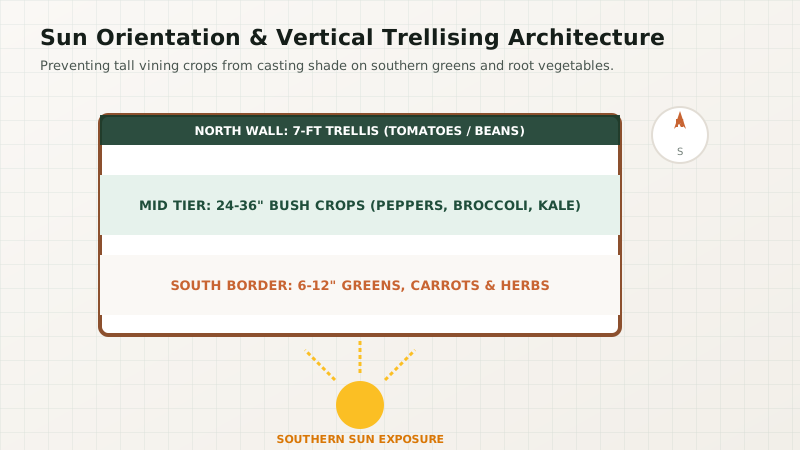
The 3-Step Staircase Layout
In the US, Canada, Europe, and across the Northern Hemisphere, the sun arcs across the southern sky all day long:
- Back / North Side (Tallest Climbers): Put tall trellised plants—like climbing tomatoes, pole beans, trellised cucumbers, and snap peas—along the north edge. Their shadows fall behind the bed into the walkway instead of covering your shorter veggies. (Flip this to the south edge if you garden in Australia or the Southern Hemisphere!)
- Middle Strip (Medium Bush Plants): In the middle section, plant mid-sized bushes (18”–36” tall) like bell peppers, eggplants, bush tomatoes, kale, and broccoli.
- Front / South Edge (Lowest Crops): Along the south edge, plant low crops (4”–12” tall) like lettuce, radishes, carrots, spinach, strawberries, and marigolds where nothing casts shade over them.
6. How Many Vegetables Fit? (4×4, 3×6 & 4×8 Chart)
Here is how many plants cleanly fit inside the three classic bed sizes once you leave a proper border gap:
| Crop | Center-to-Center | Edge Gap | 4×4 Bed (16 sq ft) | 3×6 Bed (18 sq ft) | 4×8 Bed (32 sq ft) | Helpful Setup |
|---|---|---|---|---|---|---|
| Climbing Tomato | 24” | 12” | 4 plants | 3 plants | 8 plants | North trellis or sturdy cages |
| Bush Tomato | 18” | 9” | 4 plants | 6 plants | 10 plants | Short wood stakes |
| Bell Pepper | 18” | 9” | 4 plants | 6 plants | 10 plants | Center row |
| Bush Green Beans | 6” | 3” | 64 plants | 72 plants | 128 plants | Easy square grid |
| Head / Romaine Lettuce | 10” | 5” | 16 plants | 21 plants | 36 plants | Plant small batches every 2 weeks |
| Kale / Collards | 12” | 6” | 16 plants | 18 plants | 32 plants | Pick outer leaves as they grow |
| Broccoli / Cabbage | 18” | 9” | 4 plants | 6 plants | 10 plants | Center line with room |
| Carrots | 3” | 1.5” | 256 carrots | 288 carrots | 512 carrots | Direct seeds in deep soil |
| Garlic | 6” | 3” | 64 bulbs | 72 bulbs | 128 bulbs | Plant cloves in autumn |
| Strawberries | 12” | 6” | 16 plants | 18 plants | 32 plants | Trim extra runners for bigger berries |
7. Double Your Harvest With 3-Season Planting
You can pull two or three full harvests from the exact same raised bed each year by swapping crops with the weather:
Wave 1: Cool Early Spring (March – May)
Sow cold-loving greens, peas, radishes, and spinach. They sprout happily in chilly soil and brush off light spring frosts.
Wave 2: Warm Summer Harvest (May – August)
As you pull early radishes and spinach in late May, tuck summer tomatoes, peppers, basil, and cucumbers right into those freshly cleared spots.
Wave 3: Crisp Fall & Winter Roots (August – November)
In late summer, sprinkle carrot, turnip, leek, or fall kale seeds in the light shade beneath your tall tomato vines. When October frost clears out the tomatoes, your fall crops already have a big head start and keep producing under a simple frost cloth.
Frequently Asked Questions
Can I build a raised bed wider than 4 feet?
It’s usually best not to! Once a bed hits 5 or 6 feet wide, you can’t weed, plant, or pick fruit in the middle without climbing onto the dirt. Stepping into raised beds squishes air pockets, crushes helpful soil fungi, and packs down the loose mix.
Should I put gravel or rocks in the bottom of a raised bed for drainage?
No—that popular tip actually traps water instead of draining it! Water doesn’t like moving from fine, spongy garden soil down into coarse gravel until the upper soil is completely soaked and waterlogged. Fill the whole frame from bottom to top with the same uniform soil mix.
How do I keep gophers, moles, or voles out of my raised bed?
Before pouring in any dirt, staple heavy 1/2-inch galvanized hardware cloth (sturdy wire mesh) flat across the bottom of the wooden frame. Skip flimsy plastic netting or chicken wire—burrowing rodents chew right through those.
Helpful Interactive Calculators
- Raised Bed Spacing Calculator — Pick 4×8, 4×4, or custom timber sizes to map your plants and calculate Mel’s Mix soil bags.
- Square Foot Gardening Calculator — Paint crops onto a 1×1 ft square bed planner to tally every vegetable at a glance.
- Master Vegetable Spacing Chart — Quick spacing numbers across 30+ popular backyard vegetables.
- Main Garden Spacing Calculator — Test any bed size in feet or meters and print a clean garden layout map.