How to Calculate Plant Spacing: A Complete, Simple Gardening Guide
Learn how to measure stem-to-stem plant spacing, leave safe edge gaps in raised beds, and fit the right number of plants without crowding.
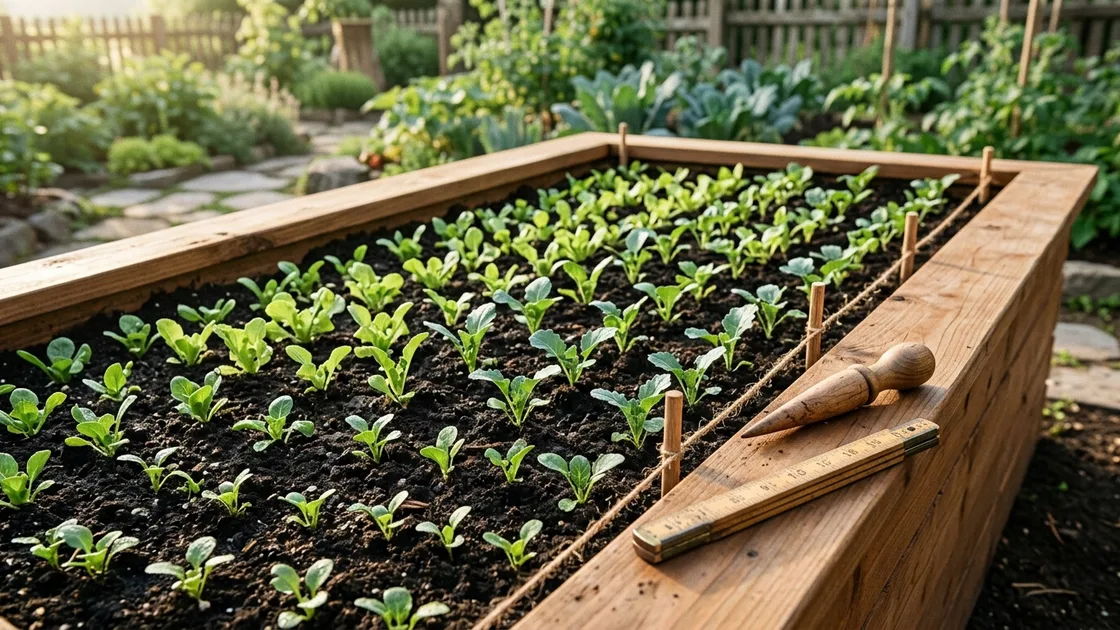
Whether you are planning a backyard raised bed, a flower border, or a large vegetable patch, getting your plant spacing right is one of the smartest things you can do as a gardener. Good spacing decides how much sun hits your leaves, how fast morning dew dries, and whether roots have plenty of food and water without fighting their neighbors.
Unfortunately, most simple advice online tells you to just take your total bed area and divide by the square of your plant spacing (Area ÷ Spacing²). That quick math works okay as a rough guess for huge, open farm fields, but it gives wrong answers inside real garden beds where wooden frames, walkways, and wall gaps limit where you can actually dig.
In this step-by-step guide, we break down center-to-center plant spacing, show you the simple math that actually fits inside raised bed walls, explain why airflow and root room matter so much, and walk through real examples you can use today.
1. What Does “Center-to-Center” Spacing Mean?
When seed packets, plant tags, or garden charts list a spacing number, they are talking about center-to-center spacing (measuring from center to center). That means the distance from the main stem in the middle of one plant to the main stem in the middle of the next plant.
It does not mean the empty gap between nursery pots, and it does not mean the space between the tips of full-grown leaves.
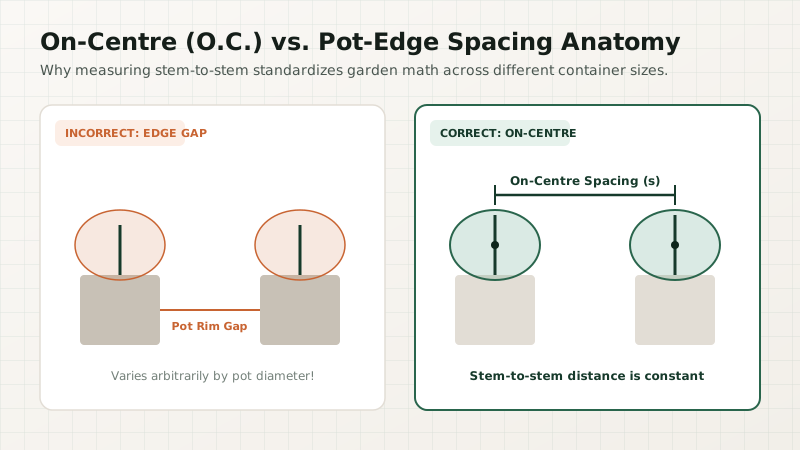
Why Measuring From Pot Edges Doesn’t Work
If you measure only the empty dirt between two nursery pots, your spacing changes depending on what size pots you bought at the garden center:
- If you put two 1-gallon tomato pots (each 6 inches wide) with an 18-inch gap between the pots, their stems actually end up 3” + 18” + 3” = 24 inches apart.
- If you plant small 2-inch starter plugs using that same 18-inch gap, their stems are only 1” + 18” + 1” = 20 inches apart.
Measuring stem to stem removes all pot-size guesswork. Because a plant’s leaves and roots grow outward in a circle around its main stem, stem-to-stem spacing ensures every plant gets the exact space it needs to grow.
2. Why Simple Area Math Fails in Raised Beds
One of the most common mistakes gardeners make is guessing plant counts by dividing total square footage by each plant’s area:
Rough Estimate = Total Bed Area ÷ (Plant Spacing × Row Spacing)
Let’s test this on a popular 4×8 ft raised garden bed (48” × 96” = 32 sq ft). Say you want to grow bush tomatoes spaced 18 inches apart:
-
The Rough Area Guess:
- Space per Plant: 1.5 ft × 1.5 ft = 2.25 sq ft
- Rough Estimate: 32 sq ft ÷ 2.25 sq ft = 14.22 → 14 plants
-
What Actually Fits Inside the Bed:
- The bed is 48 inches wide. You shouldn’t push stems right against the wooden walls—leaves get crushed and outer soil heats up and dries out.
- Leave a standard half-spacing edge gap (18” ÷ 2 = 9 inches) around all four wooden sides:
- Usable Width: 48” − 9” − 9” = 30 inches
- Rows Across: Round Down(30” ÷ 18”) + 1 = 1 + 1 = 2 rows
- Now check the usable length:
- Usable Length: 96” − 9” − 9” = 78 inches
- Plants per Row: Round Down(78” ÷ 18”) + 1 = 4 + 1 = 5 plants
- Actual Bed Capacity: 2 rows × 5 plants = 10 plants.
The simple area formula said 14 plants, which tricks gardeners into buying 40% more tomato starts than can safely fit—leading to tangled branches, leaf diseases, and smaller fruit.
3. Exact Formulas for Straight Garden Rows & Beds
To get the true plant count for any rectangular garden bed or plot, follow these quick steps:
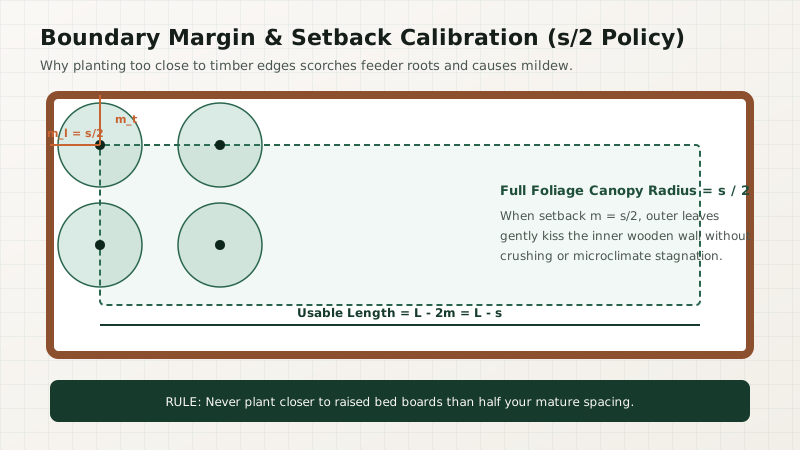
Step 1: Find Your Usable Growing Space
Start with your bed’s inside Length and Width, then subtract the edge gaps you want to leave on all four sides:
- Usable Length = Bed Length − Left Edge Gap − Right Edge Gap
- Usable Width = Bed Width − Top Edge Gap − Bottom Edge Gap
If either usable number is less than zero, your edge gaps are bigger than the bed itself, so no plants can fit cleanly.
Step 2: Count Plants per Row and Total Rows
Using your Plant Spacing along each row and Row Spacing between rows:
- Plants per Row = Round Down(Usable Length ÷ Plant Spacing) + 1
- Number of Rows = Round Down(Usable Width ÷ Row Spacing) + 1
(Note: Always round down to the nearest whole number—never round up a partial plant spot! The + 1 counts the very first plant placed right on your starting border line.)
Step 3: Multiply to Get Total Plants
Total Plants = Plants per Row × Number of Rows
4. Why Spacing Rules Matter (Sun, Airflow, and Roots)
Gardeners often ask: “If I water every day and add plenty of compost, can’t I squeeze plants closer together?” Research and real-world garden trials show three big reasons why crowding backfires:
A. Sunlight for Lower Leaves
Plants make food using sunlight that hits their leaves. When plants sit too close together, upper branches overlap early and block light from reaching the lower leaves. Instead of helping grow tomatoes, peppers, or greens, those shaded lower leaves turn yellow, drain energy from the plant, and cut down your harvest.
B. Fresh Air Prevents Common Leaf Diseases
Plant diseases spread quickly whenever leaves stay damp after morning dew, rain, or watering:
- Powdery Mildew: That white, dusty coating on squash, zucchini, and cucumber leaves thrives in still, humid air between crowded plants.
- Early Blight: Brown spots splash up from damp soil onto lower tomato leaves; tight rows stop the soil and bottom stems from drying out.
- Gray Mold: Fuzzy gray rot spreads fast through overcrowded lettuce heads and strawberry patches whenever damp leaves press together.
Giving each plant proper room keeps a gentle breeze moving through your bed so morning dew dries out within an hour or two of sunrise.
C. Underground Root Space
Roots don’t just grow straight down—in loose garden soil, shallow feeder roots spread sideways 1.5 to 2 times wider than the leafy top of the plant.
When root zones overlap too tightly, neighbors rob each other of water and key nutrients. Crowded roots drain moisture faster than soil can hold it, which causes lettuce and broccoli to shoot up to seed early (“bolt”) and causes tomatoes to suffer from dry, leathery bottoms (blossom-end rot).
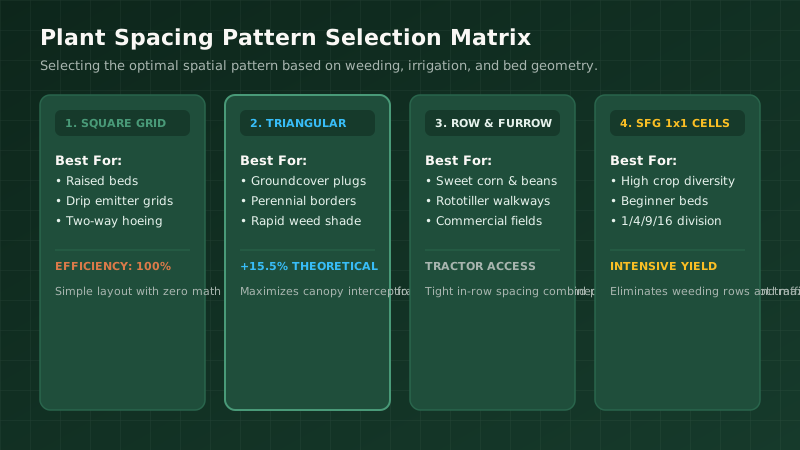
5. Planting Patterns Compared: Square vs. Zigzag vs. Rows
Different layouts make sense for different crops and garden styles:
| Planting Pattern | Row Angle | Space per Plant | Plants Fit | Best Used For |
|---|---|---|---|---|
| Square Grid | 90° (Straight) | Spacing × Spacing | Standard (100%) | Raised beds, straight drip lines, easy weeding in two directions. |
| Zigzag Triangle | 60° (Shifted) | About 87% of square | Up to +15% in big beds | Flower beds, groundcovers, strawberry patches, spring flower bulbs. |
| Wide Garden Rows | 90° (Straight) | Plant Spacing × Row Spacing | Varies | Sweet corn blocks, walkways between rows, climbing tomatoes on trellises. |
| Square Foot Gardening | 90° (Straight) | 1, 1/4, 1/9, or 1/16 sq ft | High Variety | Small kitchen beds, beginner growers mixing many veggies at once. |
6. Common Plant Spacing Reference Table
These trusted guidelines come from university gardening extensions (University of Minnesota, Cornell University, and the Royal Horticultural Society):
| Plant & Style | Support / Setup | Tight Spacing | Standard Spacing | Roomy Spacing | Row Spacing |
|---|---|---|---|---|---|
| Tomato (Bush) | Short stake or cage | 15” | 18” | 24” | 36” |
| Tomato (Climbing) | Tall string or trellis | 18” | 24” | 36” | 42” |
| Bell Pepper | Double row in raised bed | 12” | 18” | 24” | 24” |
| Sweet Corn | Short block of 4+ rows | 8” | 10” | 12” | 30” |
| Head / Romaine Lettuce | Raised bed grid | 8” | 10” | 12” | 12” |
| Carrot | Deep, loose bed soil | 2” | 3” | 4” | 6” |
| Garlic | Fall-planted cloves | 4” | 6” | 8” | 10” |
| Strawberry | Raised mound / bed | 10” | 12” | 14” | 14” |
| English Lavender | Low flowering border | 12” | 18” | 24” | 24” |
| Boxwood | Neat trimmed border | 10” | 14” | 18” | Single Row |
| Emerald Green Arborvitae | Backyard privacy hedge | 24” | 36” | 48” | Single Row |
7. 5 Easy Steps Before You Plant
Walk through this quick checklist before heading to the nursery or sowing seeds:
Step 1: Measure Inside the Bed Frame
Always measure the inside dirt space, not the outside wooden boards. A standard “4×8 ft” bed built from 2-inch-thick lumber is actually about 45” × 93” inside—almost 3 square feet smaller than 48” × 96”.
Step 2: Set Your Edge Gap
Leave half a plant-spacing gap (Spacing ÷ 2) inside every bed wall. For 12-inch-spaced veggies (like kale or peppers), plant your first row 6 inches away from the inner wood wall so roots don’t dry out and leaves don’t get cramped.
Step 3: Round Down, Never Up
Use our Section 3 formula to find how many plants fit in each row and how many rows fit across. Always drop leftover decimals (for example, 7.8 means 7 plants). Rounding up forces your last row right against the frame.
Step 4: Add a Small Safety Buffer When Shopping
A few seeds may not sprout and young seedlings can get nibbled by garden pests:
- Buy 10% extra seedlings or seeds for normal home beds.
- Buy 15% extra for bare-root perennials or strawberry starts.
- Round up to full nursery packs (4-packs, 6-packs, or trays) so you aren’t caught short.
Step 5: Preview Your Map Before Digging
Test your numbers in a free 2D garden layout calculator so you can see where every plant dot lands, check for crowded leaf circles, and print a simple planting map to take outside.
Frequently Asked Questions
What happens if I plant closer than recommended?
Plants end up fighting hard for sun, water, and nutrients. You might grow plenty of green stems and leaves, but your tomatoes, peppers, or heads of lettuce will stay small. Damp, crowded leaves also catch powdery mildew, blight, and rot much more easily.
Can I mix fast and slow plants in the same bed?
Yes! Gardeners call this interplanting. A classic trick is to space big, slow growers (like tomatoes 24” apart) and tuck tiny, fast crops (like radishes or baby spinach spaced 3”–6” apart) in the empty soil between them. You harvest and eat the radishes long before the tomato branches fill in.
What’s the fastest way to mark equal spaces in the dirt?
Many market gardeners make a simple notched planting stick. Cut a scrap board to match your bed width, then mark or screw small pegs every 6, 12, or 18 inches. Press the board gently across the raked soil and it stamps neat planting spots in seconds.
Helpful Interactive Calculators
- Main Garden Spacing Calculator — Draw a live 2D planting map, zoom in, save a printable SVG diagram, and estimate costs.
- Raised Bed Plant Spacing Calculator — Built-in 4×8, 4×4, and 3×6 bed presets with a raised bed soil volume calculator.
- Zigzag (Triangular) Spacing Calculator — Check whether zigzag rows add or lose plants inside your exact bed size.
- Master Plant Spacing Charts — Quick lookup tables for 50+ vegetables, flowers, fruits, and privacy hedges.